PayProbe Platform
A Digital Twin of a
Payment Network
The free tools on this site help you decode and compute. The Platform lets you build and run an entire payment network on your laptop — issuers, acquirers, switches, HSMs and simulators, wired together and started with one click. Self-hosted, on your infrastructure.
Live demo sign-in: admin / admin
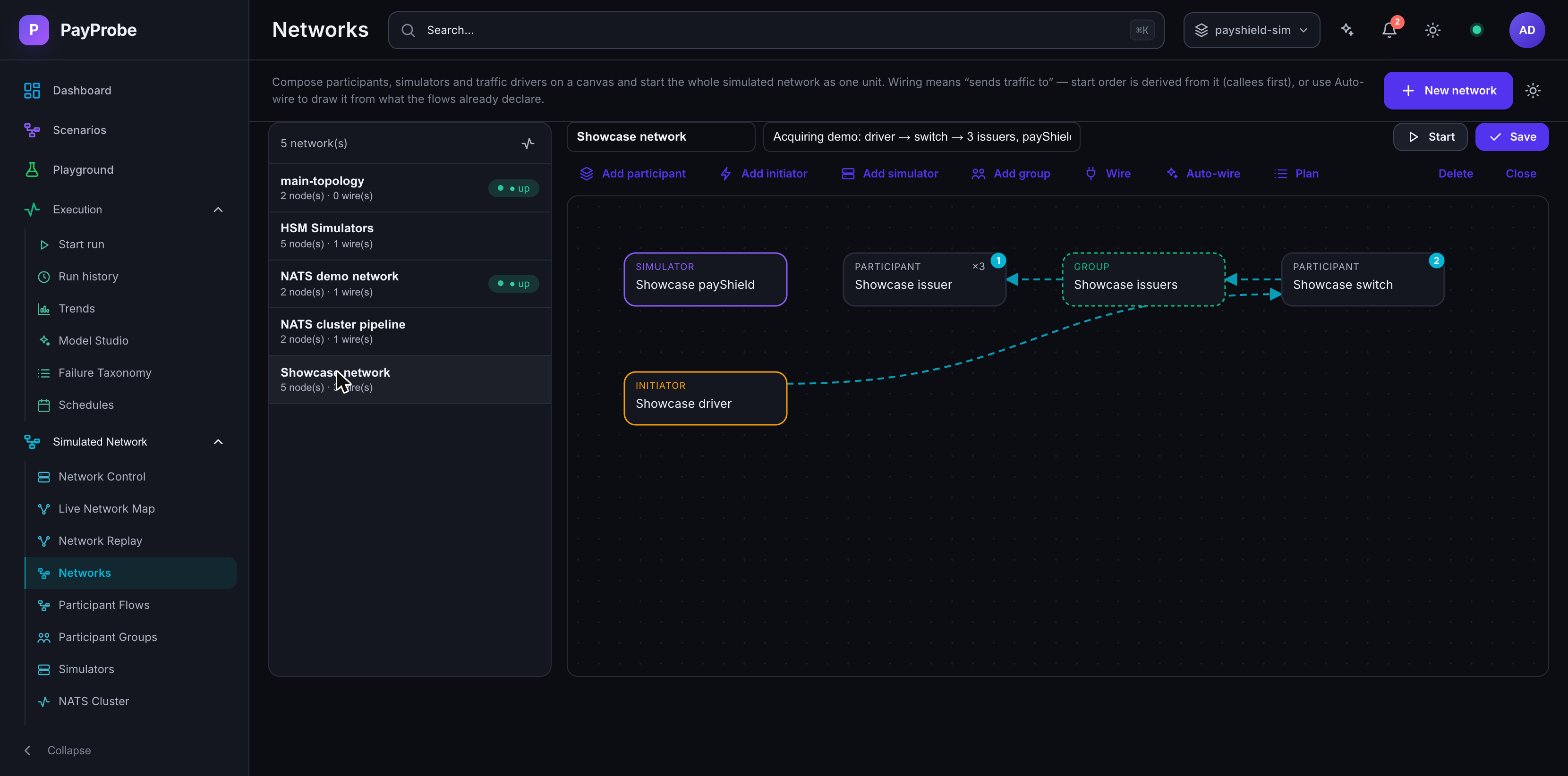
Demo
Watch a network come alive
One click on the canvas, and every participant starts in dependency order — then the map lights up with live traffic.
Prefer to click around yourself?
A running instance of the Platform is open at demo.payprobe.io. Sign in with admin / admin. It is a shared sandbox — don’t enter real card data or keys.
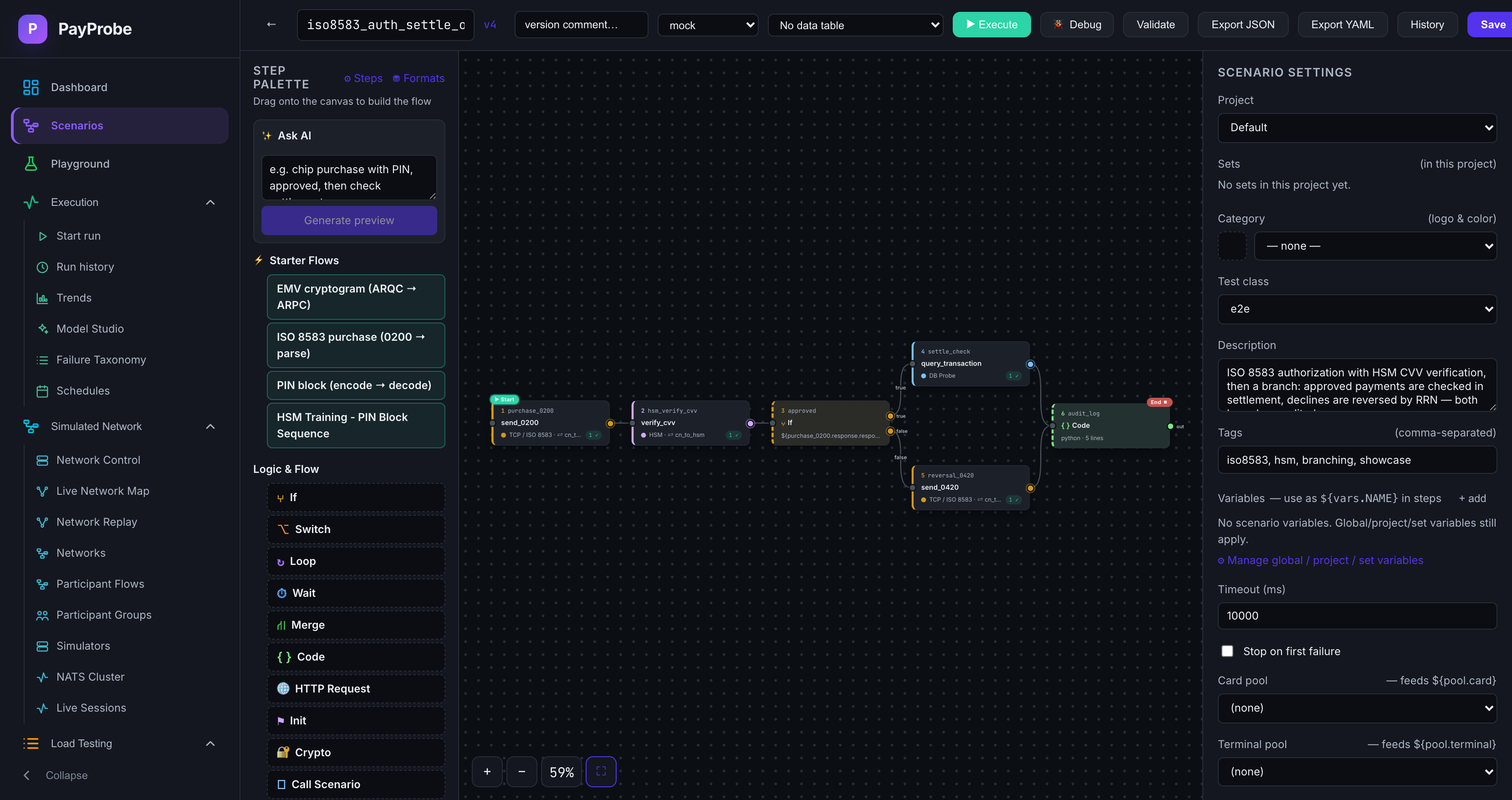
Scenario Constructor
Build test scenarios on a canvas
Drag protocol steps onto a canvas and wire them with edges that mean "then". A scenario is the exact sequence your system under test will face — visible at a glance, not buried in config files.
- Steps cover ISO 8583 messages, HSM commands, REST calls, assertions, variables, loops, and branching.
- Scenarios are validated before they run — broken wiring and missing inputs surface at design time, not mid-run.
Protocol Simulators
Every counterparty, simulated
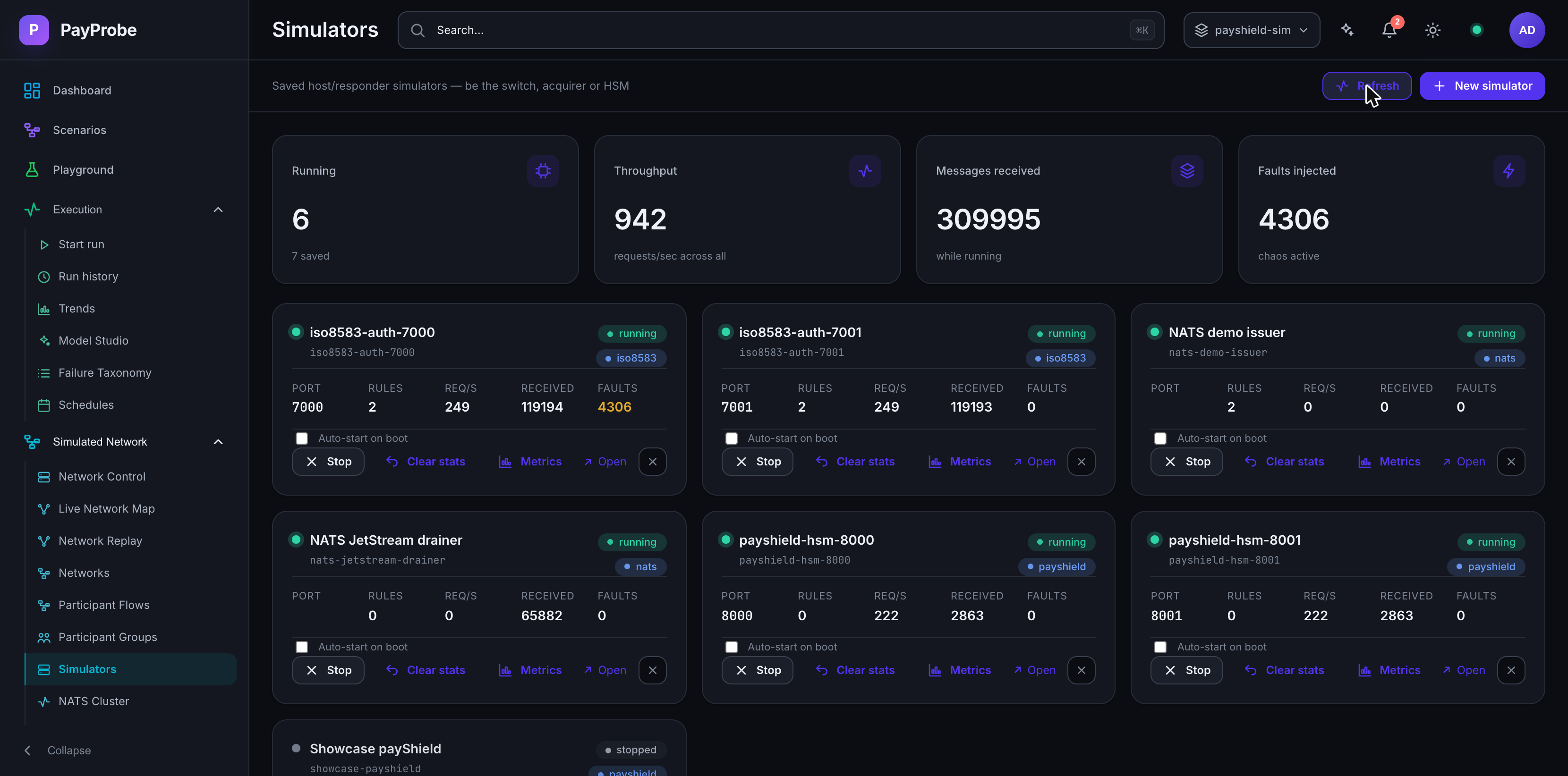
Built-in simulators for ISO 8583 hosts, Thales payShield HSM, VISA Base I, CyberSource REST, and NATS messaging. Start one in seconds and point your system under test at it.
- Script each simulator’s responses — including EMV/ARQC cryptography.
- No physical HSM, no scheme sandbox queue: the counterparty runs on your machine.
Networks — The Digital Twin
Author the whole network, start it with one click
Place listening participants on a canvas — issuers, acquirers, switches, HSMs, simulators — and wire them with edges that mean "sends traffic to". The result is a digital twin of a payment network.
- One click starts every participant in dependency order.
- Run everything on one machine, or spread participants across a distributed fleet.
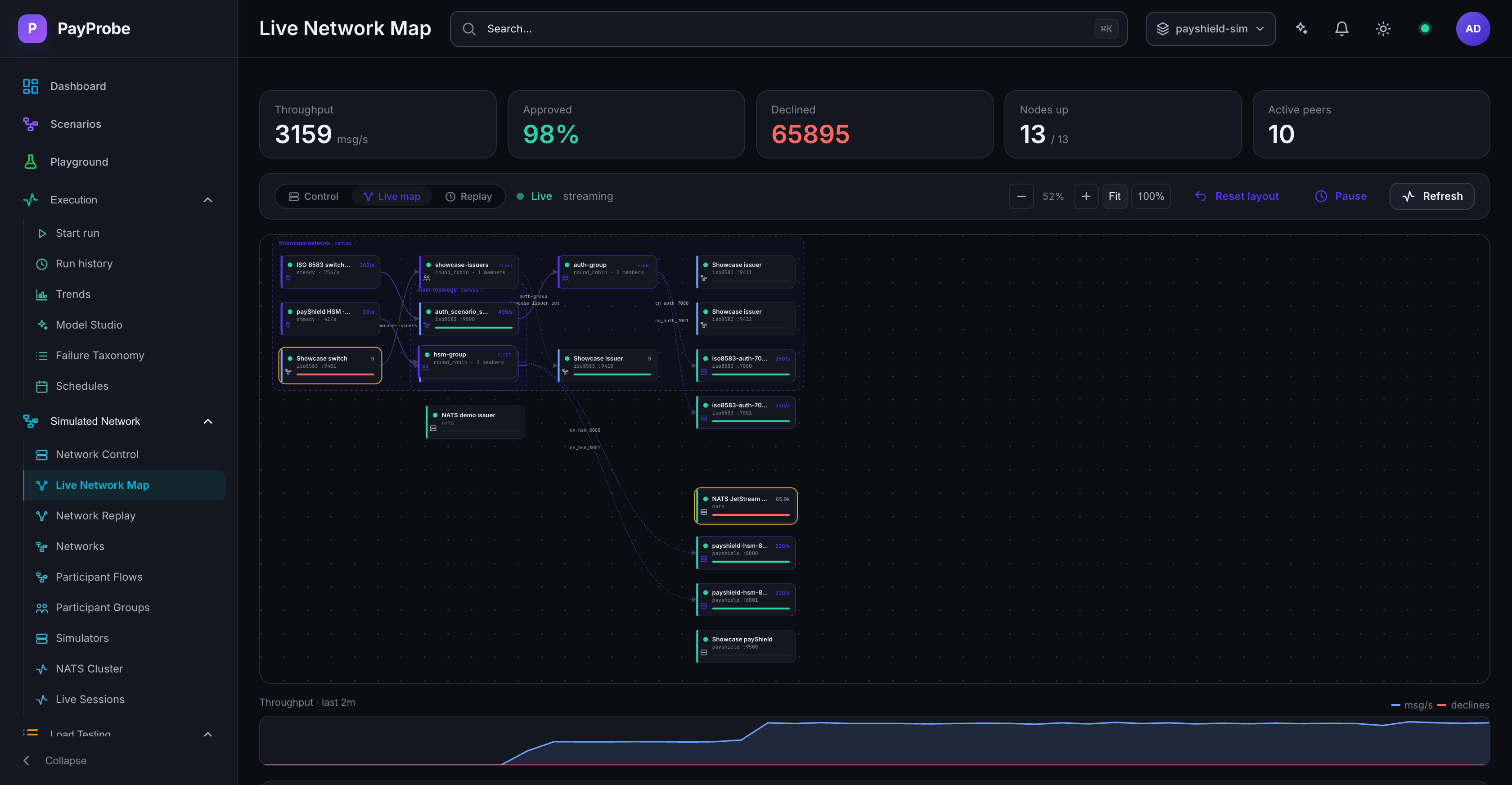
Live Network Map
Watch the traffic move
While a network runs, an animated map shows traffic flowing between participants in real time. It is the same picture you sketch on a whiteboard — except it is live.
- Per-participant health at a glance.
- Drill into message traces for any hop on the map.
Distributed Load
Load generation that scales past one box
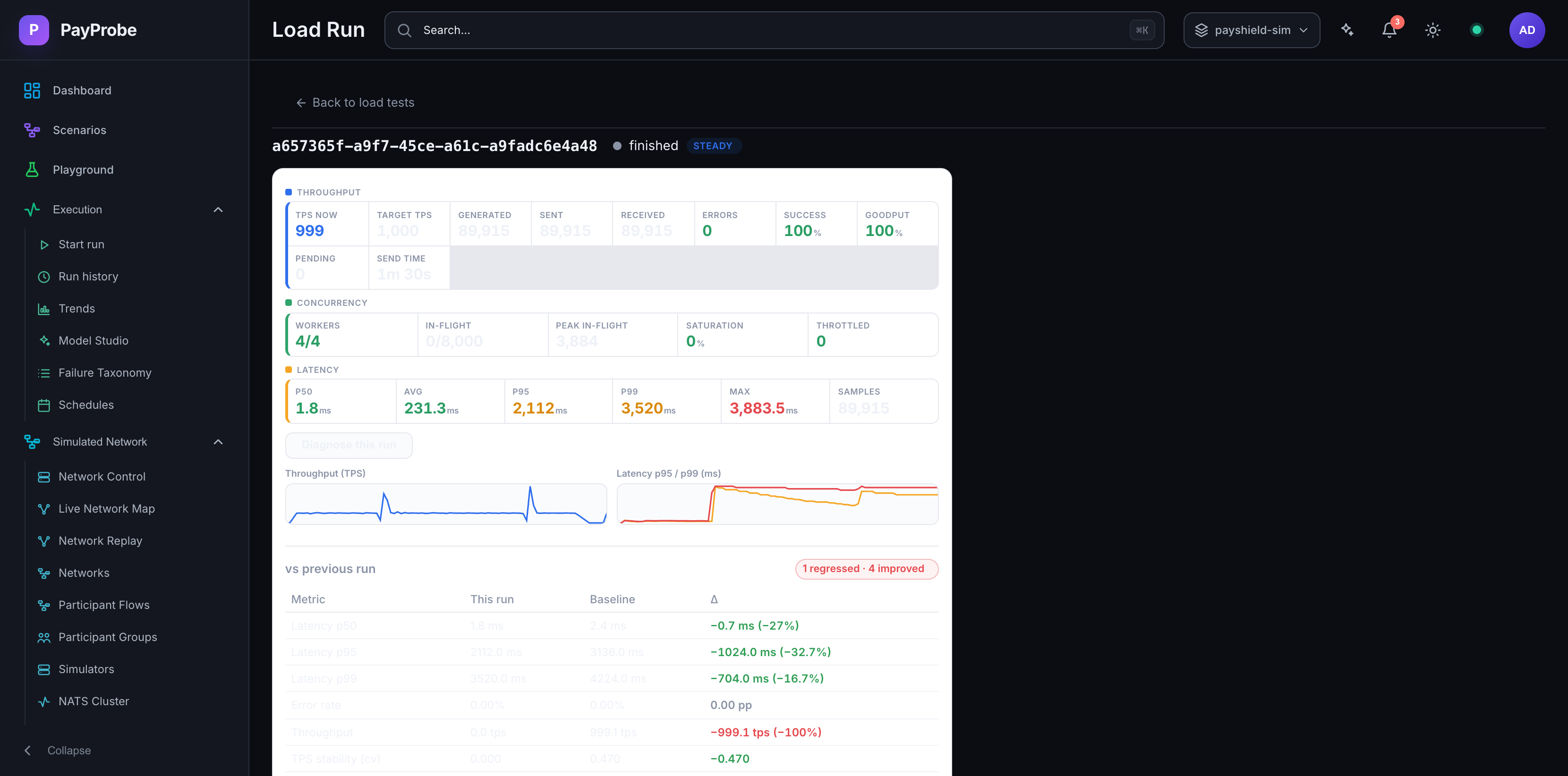
Generate traffic from a fleet of load workers instead of a single machine, and measure how the network behaves as volume climbs.
- Track latency percentiles and throughput per run.
- Compare load runs side by side to catch regressions between builds.
Chaos & Resilience
Break it on purpose, certify the result
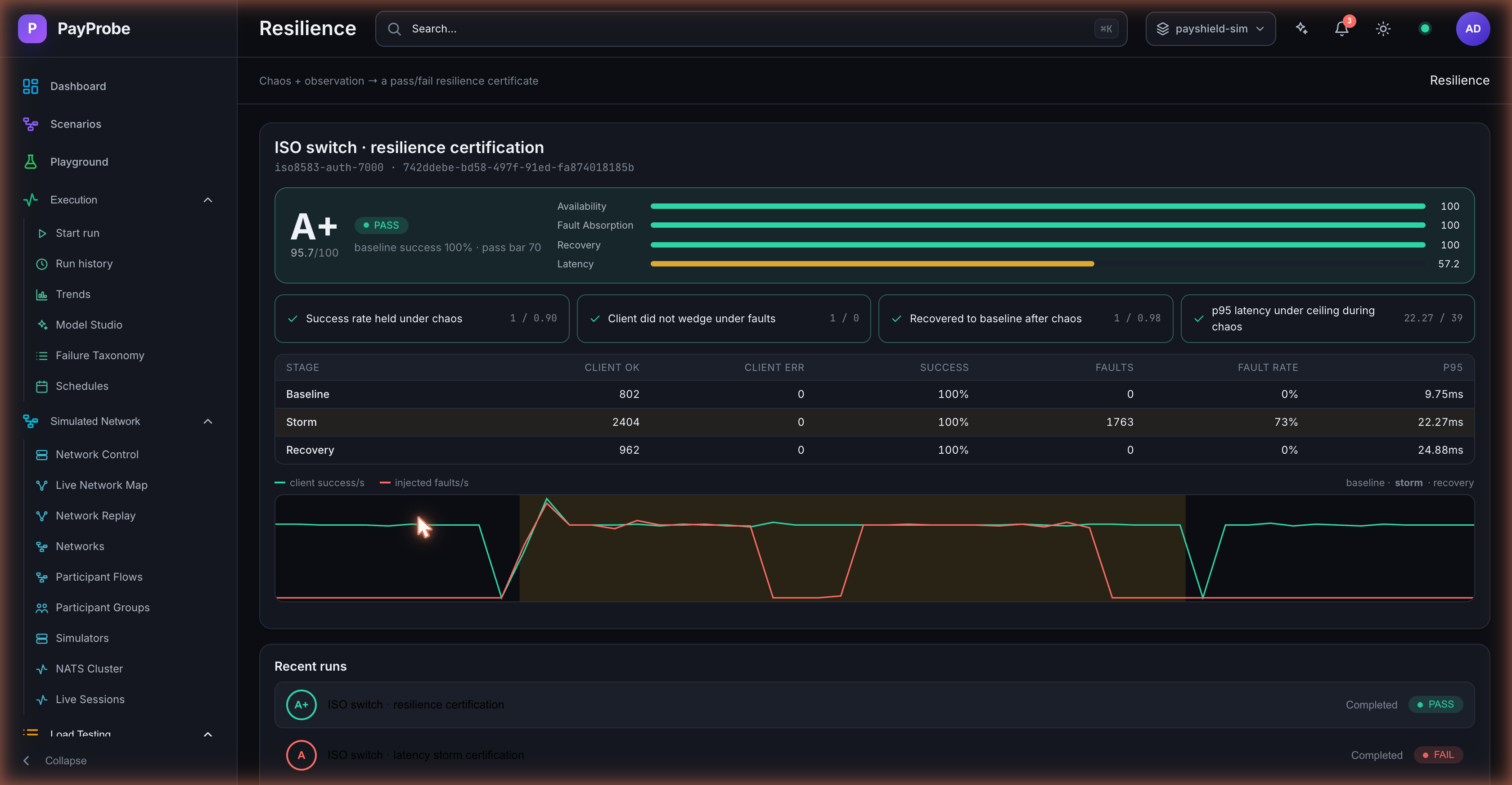
Inject faults into simulators mid-run — latency, drops, error storms — and watch how the rest of the network copes. Then make it repeatable.
- Run scripted resilience campaigns instead of one-off experiments.
- Get pass/fail certification against defined gates.
Run Reports & Sign-off
Reports with gates, releases with signatures
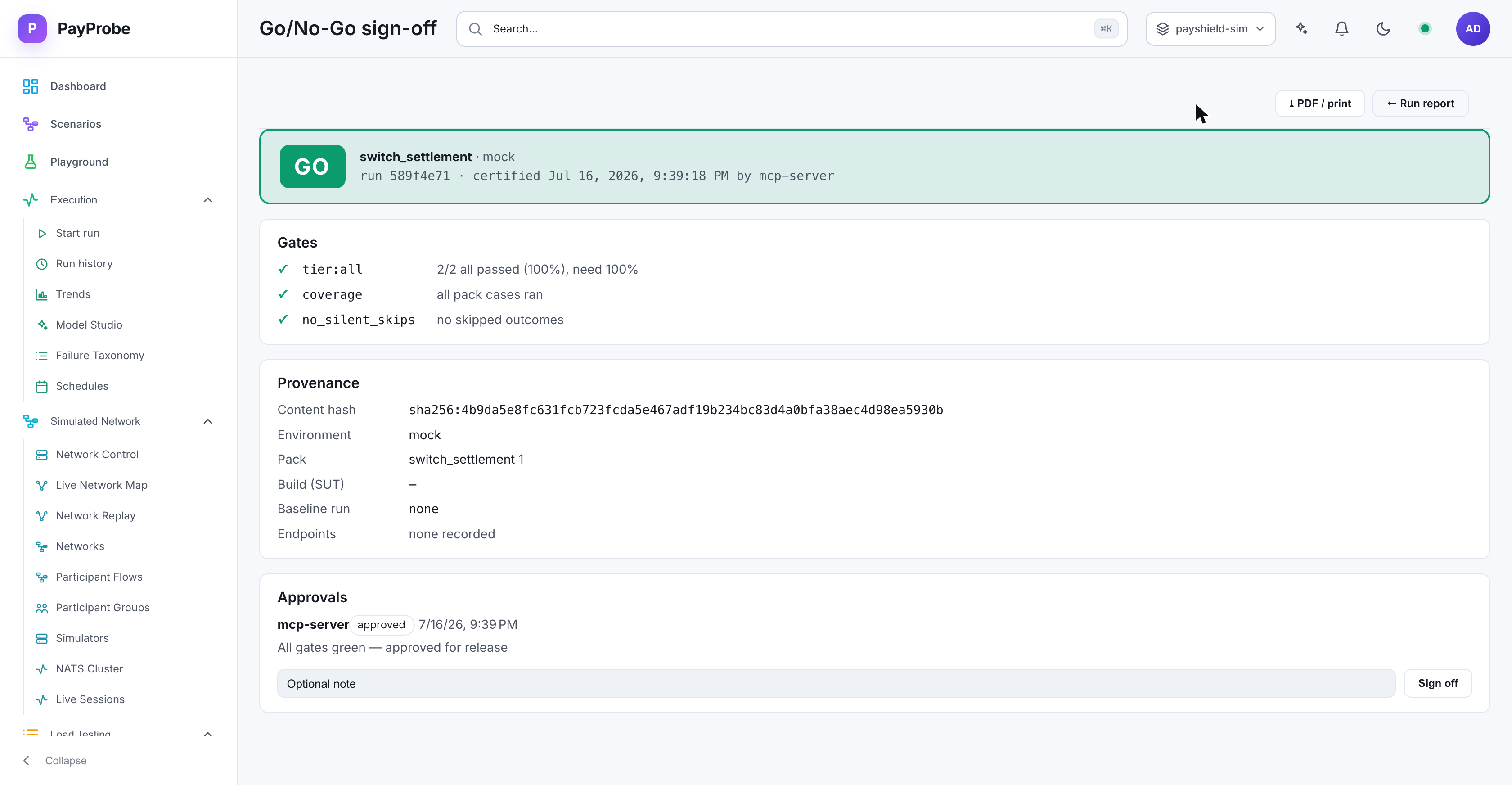
Every run produces a report with gates and provenance — what ran, against what, and whether it passed. Releases get an explicit Go/No-Go decision.
- Gate results and provenance captured on every run.
- An approve/reject sign-off trail records who cleared each release, and when.
Assistance & Insights
An assistant that builds, insights that advise
Automation helps you construct; analytics help you understand. Neither one gets to overrule you.
Built-in AI assistant + MCP server
An assistant that builds scenarios, connections, and whole networks for you. Every write it makes is journalled and reversible. An MCP server exposes the entire platform to external agents like Claude.
Advisory ML insights
Failure categorization, explanation, and outcome prediction on runs. Read-only and advise-only — insights never gate a run or block a release.
Supporting Registry
The plumbing, managed in one place
Everything a scenario or network references lives in a shared registry.
Message format editor
Define and edit the wire formats your participants speak.
Environments
Per-environment override matrices — same scenario, different targets.
Encrypted secrets vault
Keys and credentials stored encrypted, referenced by name.
Card & terminal pools
Reusable pools of test cards and terminals for scenarios and load runs.
Test keys
Managed test key sets for EMV, PIN, and HSM operations.
Run your own payment network
The Platform is self-hosted — it runs on your hardware, inside your perimeter. One Docker Compose command brings it up.